You Can’t Stay Here: Faith That Moves Beyond the Mountaintop
Luke 9:28-36
Introduction: A Story of Disfiguration
Have you ever seen something that had fallen into a state of disrepair? Perhaps a barn? An antique car? Or a house that was once beautiful but now sits with peeling paint, sagging steps, and shingles that are curling at the edges? Maybe it was a place that had once been full of life, but over time, neglect and wear took their toll, leaving it a shadow of its past glory.
I remember the first time my wife and I walked through what would become our first house. We were expecting our first son, Asher, who is now 10, and with a baby on the way, we knew it was time to find a place to make a home. The house had been well-built in the 1950s, and at one time, it had been well cared for. But by the time we saw it, it had fallen into disrepair. Every room on the main floor had a different type of ugly flooring—none of it matched. The walls were covered in layers of outdated wallpaper, some with peeling floral borders. The upstairs bathroom had a pink bathtub, and the basement had that old orange shag carpet that was once all the rage and recently the original wood paneling had been painted a soft pink! As we walked through, my wife was nearly in tears. “I cannot live in this house,” overwhelmed by the reality of the mess. But as I wandered through, my eyes were wide with excitement. Not because of how it looked at that moment, but because I could see what it could become. I wasn’t focused on its current state of disfiguration—I was beginning to dream of its transfiguration.


Transfiguration: A Glimpse of Glory
The Transfiguration of Jesus is one of the most striking moments in Scripture. Peter, James, and John follow Jesus up a mountain to pray, and suddenly, His appearance changes. His face shines like the sun, His clothes become dazzling white, and Moses and Elijah appear beside Him. A cloud descends, and a voice from heaven declares, “This is my Son, whom I have chosen; listen to Him.”
But what exactly is transfiguration? One of our quilters has a church calendar and boldly told me this week: “This Sunday is Transfiguration Sunday!” But what does that word mean? It means a complete transformation that reveals a deeper truth. Jesus wasn’t simply glowing for dramatic effect—His divine nature was being unveiled. The disciples had followed Him as a teacher and miracle worker, but here, they saw Him for who He truly was—God in the flesh.
The Old Testament Foreshadowing: Moses on the Mountain
The story of Moses on Mount Sinai provides a powerful parallel. In Exodus 34, Moses ascends the mountain to meet with God and receive the Ten Commandments. When he comes down, his face reflects God’s glory so intensely that the people are afraid to look at him. He has to veil his face because it shines so brightly.

Throughout Scripture, mountaintops are places of divine encounter. Moses meets God on the mountain. Elijah hears God in the whisper on the mountain. Jesus is transfigured on the mountain. These moments reveal glimpses of God’s presence. But there is a key difference: while Moses’ face reflected God’s glory, Jesus radiated it from within. Moses was like the moon, reflecting the sun's light, while Jesus was the source of the light itself. The transfiguration wasn’t just about Jesus experiencing God—it was about revealing His divine identity as the Son of God. Yet, as incredible as that moment was, neither Moses nor Jesus stayed on the mountain. Faith isn’t just about seeing glory—it’s about what happens when you step back down.
A Closer Look at Luke 9:28-34
Luke tells us that Jesus took Peter, James, and John up the mountain to pray. This moment follows Jesus’ warning that He would suffer, die, and rise again (Luke 9:22). The transfiguration happens in the shadow of the cross.
As Jesus prays, His face shines, and His clothes become dazzling white. Moses and Elijah appear, representing the Old Testament scriptures of the Law and the Prophets, speaking with Him about His coming departure (exodus in Greek), foreshadowing His death and resurrection. The disciples, groggy with sleep, wake to witness this divine revelation. Overwhelmed, Peter blurts out, “Let’s build three shelters!” He wants to stay in this holy moment. But before he can act, a cloud—representing God’s presence—envelops them, and the voice from heaven speaks: “This is my Son, whom I have chosen; listen to Him.” This moment confirms Jesus’s divine identity, but it also serves as a reminder: they cannot stay on the mountain. The journey of faith calls them forward.
Transfiguration in Literature: A Surprising Parallel
You might be surprised to learn that transfiguration—a transformation that reveals a deeper truth—shows up in literature as well. One of the most striking examples comes from C.S. Lewis’s The Voyage of the Dawn Treader.

In the book, there’s a boy named Eustace Scrubb, and as Lewis bluntly puts it, he “almost deserved” such an awful name. That’s how unlikeable he is! Eustace is selfish, whiny, greedy, and completely lacking in imagination or kindness. He complains about everything, thinks only of himself, and treats others with arrogance and contempt.
During a voyage, Eustace stumbles upon a dragon’s hoard of gold, greedily slips a golden bracelet onto his arm, and falls asleep on the treasure. When he wakes up, he has been transfigured—not into glory, but into a dragon! His outward form now matches what had been true of him all along—his greed, selfishness, and isolation.
At first, he is terrified, but slowly, something changes. Being a dragon forces him to realize how miserable he has been. Then, Aslan—the Christ figure of the story—appears and tells him that if he wants to be restored, he must shed his dragon skin. Eustace tries to claw it off himself, but each time, another layer remains. Finally, Aslan tells him, “You must let me do it.” When Aslan reaches out, his claws cut deep—deeper than Eustace could ever go on his own. It is painful, but it is only in surrendering to Aslan’s work that he is truly transformed. The dragon’s skin is peeled away, and Eustace is restored—not just to his human form, but to a changed heart. This is what true transfiguration is about. It’s not just an outward change—it’s a transformation that only God can accomplish. And like Eustace, we cannot do it on our own. Real transformation requires surrender to Christ.
Transfiguration in Art: Raphael’s Theological Vision
In our church bulletin today and on the screen in the sanctuary, you’ll see an image of Raphael’s The Transfiguration—and that’s no coincidence. Religious art isn’t just about beauty; it reflects a theological interpretation of reality. Raphael’s masterpiece does more than capture the dazzling glory of Christ on the mountaintop—it also forces us to confront the reality of the broken world below.

At first glance, the painting is divided into two distinct sections. The upper half is luminous, full of divine radiance. Jesus is at the center, His body suspended in glory, flanked by Moses and Elijah. His garments shine with a brilliance that symbolizes His divine nature, and the use of bright, contrasting colors draws our eyes upward to this moment of revelation. This is the Christ who is fully God, the fulfillment of the law and the prophets.
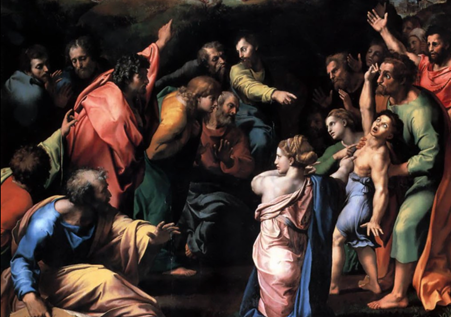
But then, our eyes are pulled downward. The lower half of the painting is chaotic, dark, and almost frantic. Here, we see the scene from the very next passage in Luke 9:37-43—the moment Jesus descends from the mountain and is immediately met with a desperate father and a demon-possessed boy. While the disciples above bask in divine revelation, the figures below writhe in confusion and suffering. It is a stark contrast—glory above, brokenness below.
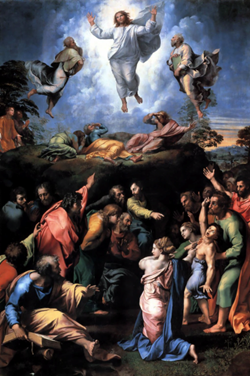
Raphael’s decision to combine these two moments is profoundly theological. Peter wanted to build shelters to abide in the glory of the mountaintop experience. But Jesus didn’t stay. The incarnate Christ comes down. He leaves the brightness of the mountaintop and steps into the pain and struggle of the real world. Because transfiguration isn’t just about seeing glory—it’s about what happens after. It is a call to action, a reminder that faith moves us from revelation to restoration. Jesus shows us that true glory is found in descending into the suffering of humanity to bring healing.
Transfiguration in Everyday Life
One of the concrete ways to live out transfiguration is through presence—showing up in the lives of others. Jesus didn’t stay on the mountain because real ministry happens in the valleys. We live in a world full of people who are struggling—those facing loneliness, dealing with loss, navigating change, or searching for purpose. Sometimes, transformation doesn’t come through grand gestures but through the small, faithful acts of being with people—listening, praying, and sharing life.
A story about a colleague of mine: for years, Tammy faithfully supported her husband, who was a pastor, while raising their four children and serving in their local church. But as her kids grew older, she felt drawn to the university campus, a place filled with young people navigating big questions about life and faith. But when she expressed her desire to step into campus ministry, some denominational leaders were skeptical. She had no theological degree, no formal ministry experience – what could she possibly offer?

What she had was presence. She showed up. She started building relationships. And she brought muffins. That’s right—muffin diplomacy. Tammy realized that something as simple as fresh-baked muffins and a conversation could open doors. She sat with students, listened to their experiences both good and bad and became a steady presence in their lives. What started as small, faithful acts became transfigurational. 15 years later, Tammy’s presence has reshaped the spiritual landscape of that university for many students. She has walked with students through doubt and discovery, grief and joy. She didn’t wait for permission. She didn’t wait to feel qualified. She simply participated.
Tammy’s story reminds us that transfiguration isn’t just about what happens to us—it’s about stepping into the places where transformation is needed and being present for the work God is already doing. Sometimes, all it takes is a willing heart, a listening ear, and maybe even some homemade muffins.
Conclusion: Faith that Moves Beyond the Mountaintop
Throughout Scripture, in the Old Testament, in art, in literature, and in everyday life, transfiguration is a moment of transformation that reveals a deeper truth. Moses reflected God’s glory, Raphael captured both the mountaintop and the valley, and Eustace Scrubb had to surrender to be made new. But at the heart of it all is Christ—transfigured before His disciples, revealing His divine nature, and calling us forward into a transformed life.
But here’s the challenge: You can’t stay here. The temptation of nostalgia is real. It’s easy to hold onto past experiences, to build a monument for what once was, just like Peter wanted to do on the mountain. But Jesus calls you forward. If you have glimpsed the glory of Christ in a new way today, don’t let it remain just a moment. Let it move you. Let it change you. Listen to Him. Step into what He is calling you to do and who He is calling you to be.
And as a church, we can’t stay here either. We honour the history we have inherited, and we give thanks for those who have gone before us—faithful leaders like JJ Thiessen, whose dedication helped the foundation for this community of faith. Their legacy is a gift, but it is not a destination. We do not exist to simply preserve their work—we are called to build upon it. To step forward in faith and to embrace the story that God is writing today. That story includes the people in this room right now. And it also includes those whom God will bring to us in the days ahead. Like Jesus, we must walk down the mountain and embody a faith that touches real people in real places, with real needs. Our community, our city, needs the presence of a transfigured people—people who themselves have been transformed and now radiate the image of Christ wherever they go.
So, will you follow Him? Will we follow Him? Because you can’t stay here. And we can’t stay here. Faith moves us forward. As we have ascended the mountain to see the glorious presence of Jesus, let us also now descend with a faith that moves us beyond the mountaintop.
Read more ...
“Living together – the story we share”
1 Corinthians 15:1-11 (February 9, 2025)
Today we arrive at the third and last in a series of sermons using the lectionary texts from Paul’s first letter to the Corinthians. It’s also my last sermon together with you. So you’d think I could come up with some profound, stunning new insight to leave. But alas, as I’ve said all along, these passages remind us of familiar things in the life we share together.
 The Christian faith has been handed down through generations – two thousand years, for goodness sake. That’s not to say we shouldn’t hear it in a fresh new way. Or that the Spirit cannot lead us to new insight and understanding.
The pastor of the first pilgrims to arrive in America told them before they departed, “The Lord hath yet more light and truth to break forth from his holy word.”[1]
So don’t go thinking we can just retreat into the past. The Spirit has always led followers of Jesus in bold new directions.
✠
But before we go any further today, I want to ask if there is a favourite story that you remember from your past.
When I grew up, the Hardy Boys were all the rage. These fictional teenage brothers had exciting adventures and solved mysteries. I read the books voraciously.
What stories have stuck with you over time? Which authors have been most influential: Shaping your point of view? Inspiring? Enlarging your life?
The prominent Canadian author, Margaret Atwood, has said: “You’re never going to kill storytelling, because it’s built into the human plan. We come with it.”[2]
In other words, we are, by nature, storytellers. Whether written and published in a book. Or shared verbally around a blazing fire – like I imagine those ancient Hebrews did, as they reflected on their place in God’s creation. Sometimes we simply repeat them silently to ourselves. The stories we tell take many forms, but there’s no getting away from them.
✠
What we have in our scripture today is a foundational story of our faith. Without it, none of us would be here, in this church. In any church.
“Now I would remind you,” writes the apostle Paul, “of the good news that I proclaimed to you, which you in turn received …” Paul too is reminding people about something they’ve heard before. “I handed on to you as of first importance what I in turn had received …”
Paul heard a story that changed his life. Then he shared it with others, including the Corinthians. And it changed their lives too. So we are all drawn in to something bigger than ourselves. A community. A way of life. A set of values. A lens through which to view the world.
Where did you first hear the gospel story? How did you find out about it?
I can remember my mom reading to me from a Bible Story book at bedtime. I also remember a Sunday School teacher who loved her students into life. I remember Uncle Donald and Aunt Jean helping me to memorize the 23rd Psalm. I remember the pastor of my church, who prepared me for baptism. So many people who, like the apostle Paul, had received the Good News, and now were sharing it with me!
Can you name some of those folks in your life? Can you say when the story finally began to sink in? How did it touch you? What was its appeal? Why do you hold on to it, even still?
✠
“For I handed on to you as of first importance what I in turn had received …”
I’m struck by that phrase “first importance.” We’re not talking about side matters, controversies. Even denominational distinctives – as important as these may be.
Serving with you has reminded me that the whole church is bigger than any of its parts. I’m grateful that you’ve welcomed this “outsider” into your midst, introducing me to Mennonite ways. Though I feel I’ve barely scratched the surface. (By the way, I received the Anabaptist Study Bible you gifted me, and am looking forward to using it in the days to come.)
Paul tells us to stay focussed. Hold to the centre. Allow that to inform who we are and the way we live.
There’s a lot of crazy chaos in the world right now, some of it rather serious. The church too can get sidetracked into silly things.
I value this wise motto, which you may have heard before: “In essentials, unity; in non-essentials, liberty; in all things, charity.”[3] That sentiment should always be our guide.
✠
So what is the essential thing, the story at the heart of our faith? Can you tell me?
 For the apostle Paul, it boils down to this: Christ died for our sins, was buried, and was raised on the third day. All of this in accordance with the scriptures.
You see, it all fits into a much longer narrative, that goes back to the beginning of time. The story of a God who created the world, and called a people, and walked with them, and loved them through thick and thin. The story of Jesus grows out of that.
No wonder Easter has always been the great celebration at the heart of our faith community. No wonder we meet to worship every “Lord’s Day,” the first day of the week. Death and resurrection. A life given in love. New life promised to God’s creation!
The story of Jesus is simple, but life-changing. Paul says the Corinthians are being saved by it. Changed, redeemed, altered. For good! Jesus has a way of doing that to us, doesn’t he?
“I love to tell the story, ’Tis pleasant to repeat what seems, each time I tell it, more wonderfully sweet. …”[4] It’s amazing how this story’s been handed down, all these years. Still fresh, powerful. Still incredibly “sweet”.
✠
 There’s a point at which the story of Jesus and our own personal stories are bound to intersect.
I picture it like those two disciples on the Emmaus Road. Remember how it goes?
They’re walking along the path, living out their lives – which happened to be grim and rather hopeless.
We all have our stories: Some are sad and some are joyful. And probably, for most of us, it’s a mix of both.
So these two are walking along, wrapped up in their own little world, when suddenly a stranger comes along. Who happens to be Jesus. But they don’t recognize him.
He opens the scriptures. Helps them to see the events they’ve been living through as part of something bigger. Which is God’s story.
And this is the point where our two narratives come to meet. Our personal stories encounter the presence and purpose of the living God.
They invite the stranger in. Bread is broken. Eyes are opened! And so they see … How everything has changed. And nothing can ever be the same. And it sends them running back to Jerusalem to tell others.
He’s alive! The one who suffered and died, has defeated death. And we have seen him and walked with him.
✠
 We all have our story. For me, it’s a pretty ordinary one.
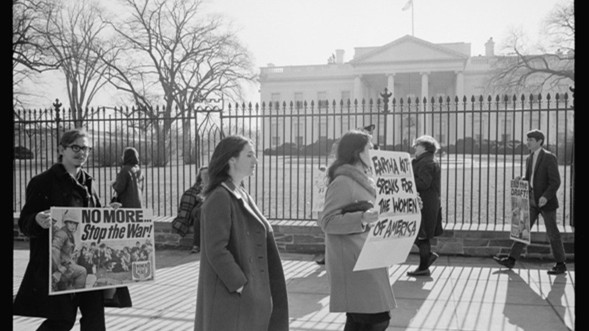
You may think our present world is chaotic, but, as I think back, I can remember all kinds of things swirling around us in the 60’s and 70’s when I was growing up, especially south of the border: The assassination of a president, the Vietnam war, race riots and civil rights, hippie culture, drugs, rock and roll, free love, a lunar landing. Here at home, we had the FLQ.
Those were tumultuous times! Many of my classmates in Sunday School stopped attending church when they reached a certain age, never to return.
But somehow God found me and hung on tight. In baptism I made a commitment, which I have never regretted.
✠
What’s your story? And tell me this: In what way has God’s story entered into it? Each one of us is unique, you know. We all have a special place here, in the community of faith, and ultimately in the Reign of God. None of our living is lost. Everything can be turned into something good and beautiful.
Paul calls himself the “least of the apostles,” unfit for ministry, because of his violence and bloody self-righteousness.
“But by the grace of God I am what I am,” he writes, “and God’s grace toward me has not been in vain.” God’s grace can take any of our lives, however broken and messed up we may be, and use us for some creative purpose.
Each of our stories may be caught up into a larger story that stretches beyond time and leads to life.
✠
But now, here’s the last thing I want to say. Stories are one thing. Sometimes we think there’s nothing to them, that they are a form of entertainment perhaps, purely fiction.

Giovanni Antonio Galli, 1585-1652.
In our passage of scripture, Paul points to the reality of Jesus’ death and resurrection. Jesus was raised “in accordance with the scriptures.”
And then he appeared! To Cephas, then the twelve. Paul says, “he appeared to more than five hundred brothers and sisters at one time, most of whom are still alive …” So ahead, ask them. This is more than fantasy.
The physical appearances of Jesus may be finished now, more or less. I’ve certainly never seen him, and I doubt I will. Those of us who follow Jesus today encounter him in a different way. But it’s no less real.
A starlit night, a moment of wondrous awe. A sound, a vision that brings me to tears. A faint echo of that voice that comes from beyond my own being. A flicker of light that will not be extinguished. A power that takes hold of me. A universe that embraces me. A “love that wilt not let me go.”
If there was no reality to the Gospel Story, it surely would have died out many years ago. And yet it persists! It’s maybe the most persistent thing on earth.
I pray that, in the days to come, the living Christ will continue to lead our congregation, and each of us individually.
We never know everything that lies ahead. We may be uncertain of the way. But we do not walk alone. The One who died, was buried, and raised to life on the third day – he goes with us. He will keep us.
✠
 That’s nothing new. I know you’ve heard it before. But I’m here … well, “To remind you, brothers and sisters, of the good news that I proclaimed to you, which you in turn received, in which also you are being saved, if you hold firmly to the message …”
It may be familiar. But it’s also the very centre of our life together in the community of faith.
Well that’s my story and I’m sticking to it! In fact, it’s a story that belongs to all of us. May we treasure it! Stand within it. Hold the message firmly to the end. Amen.
[1] https://en.wikipedia.org/wiki/John_Robinson_(pastor), Accessed February 6, 2025.
[2] https://www.azquotes.com/quotes/topics/storytelling.html, Accessed February 6, 2025.
[3] Variously attributed, but probably comes from a little-known German Lutheran theologian, Rupertus Meldenius, in 1627.
[4] Catherine Hankey, 1866. HWB #398.
“Living together – body talk”
1 Corinthians 12:12-31 (January 26, 2025)
I came to a shocking realization last week. I should have known, but somehow it eluded me, that there weren’t going to be many more opportunities to preach here at FMC. Potentially, just three more sermons in your midst! So I looked at the lectionary readings for these next three Sundays. Was there any particular theme that emerged?
The prescribed passages from Paul’s first letter to the Corinthians all have to do with living together in the community of faith. They’re familiar ones. Many of us have heard these things before. But that doesn’t make them any less relevant. Some of the most important truths deserve to be repeated, in the hope that maybe we can hear them again, in a different time, perhaps in a different way. And maybe this time they’ll stick.
So what we’re going to be doing these next three Sundays is remind ourselves of things we already know. Or should know.
✠
 Living together – that’s our theme. But let me say right at the start: It ain’t easy to live together. Even though that’s exactly what God has made us for.
It didn’t take long for good old Adam, living in that ancient garden of bliss, to grow lonely, poor guy. He had everything he could want. But one thing was missing: another human being.
So God made a second person, a partner, a companion fit for him. And that’s where things get interesting. Because here, right at the very beginning of the human race, we start listening to those slippery, snake-like voices that whisper in our ears.
And we end up making a mess of things. Plagued with all sorts of family disfunction. Including envy, blame, violence and even murder!
Despite the passage of millennia, and great strides of progress in human civilization, this brokenness is still with us. It ain’t easy to live together.
✠
 That’s exactly why Jesus came. To fix this mess – healing our destructive tendencies, and our discord, and drawing us back into right-relationship with God. And with each other. The two can never really be separated.
The apostle Paul writes to a particularly flawed gathering of believers in Corinth, whose community life had been so distorted by boastful arrogance and competing factions, that they’d forgotten the reason God had called them together in the first place.
We all know that churches can be that way. And it’s not hard to recognize the terrible irony of it: The community of Christ, breaking apart, fragmenting. Two thousand years later, not much has changed.
But the call of God remains as well: To rise above all that. To put aside our sinful selves and – by the grace of God, empowered by the Spirit, led by the person of Jesus – to walk in newness of life. “For in one Spirit we were all baptized into one body – Jews or Greeks, slaves or free …”
Paul skillfully sketches this image of what our life together is meant to look like: The body of Christ.
 ✠
✠
In our current culture it seems that everyone is in pursuit of the perfect body. A body that is slim, trim, curvaceous, rippling with muscle. A kind of body that’s beautiful to look at.
But my body has never really lived up to that ideal. And as I age, I’ve given up hope that it will. It’s scarred in places. There are bulges, and saggy bits. But I don’t want to get into that. I take comfort in the knowledge that good health doesn’t always coincide with cultural ideas of beauty.
The church is the body of Christ. Think of that for a moment: God made manifest in the world through human members like you and me! It’s a miracle, surely.
 ✠
✠
We were all baptized into one body. All of us. Regardless of our ethnic identities. Our social statuses. Our physical capacities. Jew or Greek, slave or free – it matters not a whit.
The body has many members, Paul reminds us. Exactly how many, I had no idea. So I decided to Google it. It’s hard to get a straight answer. Our bodies contain roughly 30 trillion cells. It boggles my mind!
 “The internal human body includes organs, teeth, bones, muscle, tendons, ligaments, blood vessels and blood, lymphatic vessels and lymph.”[1] All linked together by complex systems of connection and coordination.
The body has so many members, I wouldn’t know where to begin listing them all.
And the thing is, the whole creation is like that! Full of endless diversity. The stars in the sky. We shovel snow by the bucket. And every snowflake in that bucket is different from every other one.
God seems to revel in diversity and difference. How many kinds of trees in the forest? How many varieties of grass in the field? How many species of fish in the water, or birds in the air, or bugs, or animals … or human beings?
Each has their own unique place in the web of creation. And each is necessary to the well-being of the whole. Bio-diversity is a healthy thing.
So too in the body of Christ. When everyone begins to look and think and sound and act like you, that’s when you should worry!
 The body of Christ thrives with a variety of spiritual gifts, each one of us doing our own God-given thing. Shovelling snow, offering rides, preparing food, playing music, attending meetings, leading Bible study. Yes, even preaching a sermon. We all have a place.
“God arranged the members of the body,” says Paul, “each one of them, as he chose.” As God chose. It’s all God’s doing. So who are we to say to any other member of the body, “You don’t belong here.”
✠
The Corinthians were big on flashy gifts. Things that get lots of attention. And that created, in their minds, a kind of hierarchy. “My gift is better than yours.”
 And so there were some in the church all puffed up with pride. Instead of valuing cooperation and interdependence and community, they thought they could walk the road alone. “I don’t need you,” they said, dismissively.
Now let me see – where might we have heard this recently? Whenever any of us say such things about another church member, a neighbour, a political opponent, someone from a different background, who speaks another language, who sees the world in different way … whenever we dismiss anyone out of hand, the whole of God’s creation is diminished.
 “The eye cannot say to the hand, ‘I have no need of you.” Yet sometimes that’s what we do. “The head cannot say to the feet, ‘I have no need of you.” Yet isn’t there part of us that craves the security and comfort of a community where everyone is the same?
Paul says the members of our bodies which are less honourable, those weaker members are, in fact, indispensable. He claims that God gives greater honour to the weakest members of the body of Christ! All of us are made in God’s image. All of us are to be valued and respected.
So if there’s someone who’s a little slow, who can’t keep up, or doesn’t understand, or dresses differently, or has weird ideas, or doesn’t fit in with your concept of what is good and proper … Well maybe God has put that very person here for a reason.
✠
And while we’re talking about not dismissing others, let me also caution you about dismissing yourself. Sometimes we put ourselves down. We diminish our own gifts. We think we’re not good enough. We have nothing to offer.
 We look at some other incredibly talented person, and we think “how can I compete with that?” But it’s not a competition. It’s all about community. And God has put each one of us exactly where we’re meant to be. Can you believe that?
I think as we grow older, sometimes our confidence begins to wane. Because, once again, the culture around us says that we’re dispensable. That we don’t matter any more. In fact, nothing could be further from the truth.
Don’t dismiss others. Please don’t dismiss yourself!
✠
But now, let me turn from all this emphasis on individuals, and remind us that we are meant to be part of a greater whole. We are baptized into one body, says Paul.
I worry that in recent years we’ve put so much emphasis on the individual – all the rights and freedoms that we claim – we forget our collective identity. Because each one of us is  in loving relationship with Jesus we are called, therefore, to be in loving relationship with one another.
Martin Luther King Jr. called this God’s “beloved community”.
“It really boils down to this,” King said. “That all life is interrelated. We are all caught in an inescapable network of mutuality, tied into a single garment of destiny. Whatever affects one directly, affects all indirectly.”[2]
The apostle Paul put it this way: “If one member suffers, all suffer together with it; if one member is honoured, all rejoice together with it.”
We have this solidarity in the community of faith. If misfortune comes to any of us, then all of us feel the effects. No one exists in isolation.
And to the extent that any of us are raised up, healed, restored, made whole – well, that is a gift for the whole community to celebrate! One person’s success or accomplishment serves to enrich us all.
✠
 The trick is to keep our focus on Christ, who is at the very centre of our life. The centre of all our lives. The centre of creation itself!
This is the final day in the Week of Prayer for Christian Unity. Too often we focus on difference, which leads to fragmentation.
Let’s focus, instead, on that which draws us together. Let’s lift up those things we hold in common. Let’s put aside division and embrace the unity that is God’s gift. Let’s be a different kind of church. One that shows the world we can live in newness of life.
I know “it ain’t easy.” But we are the body of Christ, baptized by his Spirit. And so our lives are being drawn together, not split apart. The closer we get to Jesus, the closer we grow to one another.
After all this, Paul tells the Corinthians “I will show you a still more excellent way.” So now that I’ve wet your appetite … well, that’s for next Sunday. Stay tuned!
[1] https://en.wikipedia.org/wiki/Human_body, Accessed Januaryt 25, 2025.
[2] Martin Luther King Jr, A Letter from Birmingham Jail, 1967. https://blog.nwf.org/2024/02/diversity-in-nature-diversity-in-action/, Accessed January 23, 2025.
